Transforming Youth Lives Through Education, Training, and Sustainable Employment Opportunities Worldwide.
Physical AI Scenario Services

Scenario Services for Physical AI to Test the Real World, Safely

Use scenario-based AI services to stress-test Physical AI systems, uncover edge cases, and ship safer, higher-performing products, faster.

What We Deliver

Frame

Digital Trust and Safety Services

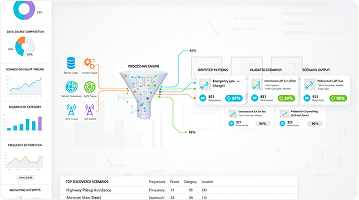
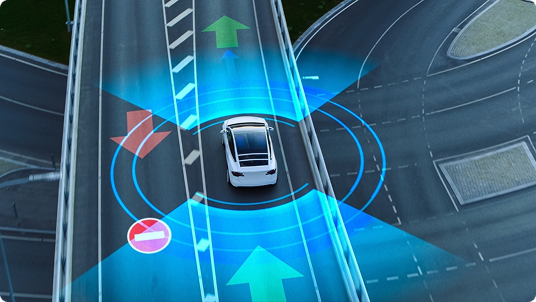
We start by extracting meaningful scenarios from your real-world logs and test runs.

Read More
  • ODD-aware filtering: Focus by geography, road type, weather, traffic patterns, or use-case.
  • Critical event detection: Collisions, near-misses, erratic actors, and non-compliant behaviors.
  • Taxonomy & tagging: Classify scenarios into nominal (everyday) and edge-case (rare, high-risk) sets aligned with your safety case and requirements.

You get a searchable, versioned library of scenarios that reflects the real conditions your system must handle.

Frame

Synthetic Scenario Generation

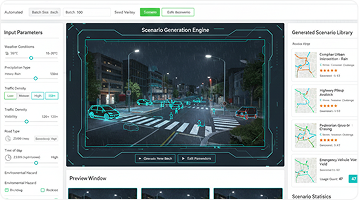
We expand your coverage by building parameterized synthetic and hybrid scenarios.

Read More
  • Log-to-sim reconstruction: Turn real-world logs into replayable simulation scenarios.
  • Parameterized variations: Adjust actors, speeds, occlusions, lighting, and weather to cover “what-if” cases.
  • Multi-sensor support: Camera, LiDAR, radar, IMU, and multi-sensor fusion workflows.
These scenarios are built to plug into leading simulation platforms and your internal tools, supporting regression test suites, model training, and validation.

Scenario Curation & Continuous Refinement

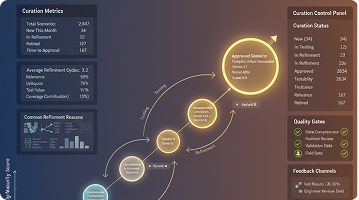
Scenario libraries are living assets, not one-off artifacts. We continuously.

Read More
  • De-duplicate & prioritize: Remove noisy or redundant scenarios and highlight those with the highest safety/performance impact.
  • Track changes over time: Version scenarios alongside model versions, maps, and ODD shifts.
  • Close the loop: Feed new incidents, field data, and customer feedback back into the library.

Result: a high-signal scenario corpus that evolves with your product.


Frame

Collision & Near-Collision Analysis

Safety-critical scenarios are analyzed in depth to support your safety case.

Read More
  • Event detection at scale: Identify collisions, near misses, and comfort-critical events in large log sets.
  • Scenario reconstruction: Rebuild incidents using physics and motion dynamics to understand root causes.
  • CAPA support: Provide inputs for Corrective and Preventive Actions, hazard analysis, and test plan updates.
You get actionable insights and scenario datasets that directly tie to safety and compliance workstreams.

Edge Case Identification & Stress Testing

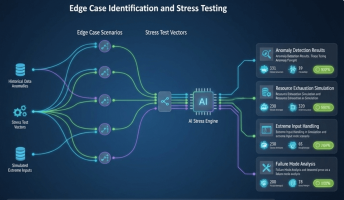
We help you systematically find and stress-test the edges of your system.

Read More
  • Rare events: Unprotected turns, occluded pedestrians, vulnerable road users, intervention-heavy segments.
  • Boundary conditions: Identify where performance degrades across speed, visibility, or traffic density ranges.
  • Test design: Build targeted scenario sets for model benchmarking, A/B testing, and regression testing.
This reduces unknown-unknowns and increases confidence before releases and geographic expansions.

Product Safety & Comfort Analysis

For consumer-facing autonomy and ADAS products, safety and comfort must move together.

Read More
  • Comfort metrics: Analyze jerk, braking, lane position, and interaction behavior vs human benchmarks.
  • Ride quality scenarios: Construct “day-in-the-life” scenario sequences to evaluate user experience.
  • Comparative studies: Compare model versions or driving policies over the same scenario bundles.

Your teams get clear, scenario-level evidence on how updates impact both safety and passenger comfort.

Accelerate Simulation, Validation, and Deployment with DDD’s Scenario Services

Simulation Ops Services
We create structured test suites covering normal, rare, and high-risk behaviors to ensure model readiness before deployment. Our teams support scenario scaling, test orchestration, defect tracking, and continuous scenario enrichment.
Digital Twin Validation Services
DDD validates dynamic agents, sensor fidelity, environmental attributes, and system performance against real-world benchmarks. This process ensures your digital twins are accurate, interpretable, and optimized for model training, safety validation, and fast iteration cycles.
ODD Analysis Services
We identify environmental, behavioral, infrastructural, and regulatory factors that influence autonomy performance and convert them into targeted scenario coverage. DDD ensures your models are trained and tested within well-defined, continuously improving ODD boundaries.
Edge Case Curation Services
Our workforce analyzes anomalies, rare behaviors, environmental deviations, sensor failures, and unpredictable agent interactions to identify and address these issues. These curated edge cases power safer model retraining, robust scenario generation, and improved generalization.

Industries We Support

Autonomous Driving

We provide large-scale scenario mining, digital twin validation, and edge-case-rich simulations to accelerate safer, faster deployment of full-stack autonomy.

ADAS

DDD delivers simulation-ready scenarios, ODD-focused coverage, and curated edge cases that strengthen perception, fusion, and decision-making safety validation.

Robotics

DDD builds real-world and synthetic scenarios for navigation, manipulation, and human–robot interaction, enabling robust ODD analysis and safer robot behavior.

Healthcare Automation

We support medical robotics with controlled digital twin validation and scenario modeling that stress-test precision, safety, and compliance in critical workflows.

AgTech

DDD creates field-ready scenarios reflecting soil, crop, terrain, and weather variability, enabling edge case curation and ODD analysis for autonomous farm machines.

Humanoids

We generate interaction-heavy, edge-case-rich scenarios and environmental variations so humanoid systems can safely adapt to complex human and workspace conditions.

Why Choose DDD?

adaptability

Human-in-the-Loop + Scalable Operations

We combine scenario-savvy subject matter experts with trained operations teams to mine and curate scenarios at scale, 24/7, across multiple time zones.

Tool-Chain Agnostic


We integrate into your existing simulation ecosystem, commercial tools, in-house sims, and data platforms, without forcing a platform switch.

Safety & Compliance Mindset

Our workflows are designed to support standards like ISO 26262, ISO 21448 (SOTIF), and NCAP-aligned test strategies by linking scenarios to requirements and test evidence.

Proven Across Autonomy & Defense

From AVs and ADAS to defense tech and robotics, DDD delivers scenario-based solutions that improve system reliability and speed up time-to-deployment.

How We Engage

Read Our Latest Blogs

Explore the latest techniques and thought leadership shaping the future of Physical AI.

Ready to Operationalize Scenario-based Testing?

Frequently Asked Questions

What are Scenario Services in the context of physical AI?
Scenario Services involve generating, validating, and curating real and synthetic environments that test AI models for safety, robustness, and performance across physical-AI systems.
What kinds of data do you work with?
Camera, LiDAR, radar, IMU, GPS, CAN bus, and derived features across on-road, off-road, and indoor environments.
Can you work with our in-house simulator?
Yes. We are platform-agnostic and integrate with your existing simulation and data tooling rather than forcing a new tech stack.
Is this only for autonomous cars?
No. Scenario Services are designed for any physical AI product where perception and control interact with complex environments, autonomous vehicles, defense systems, industrial robots, and beyond.
How does DDD support simulation and digital twin workflows?
DDD extracts and structures scenarios from fleet logs, synthetic engines, and sensor data, and validates digital twins by aligning simulation properties with real-world environments.
Why is ODD Analysis important for autonomy?
ODD Analysis ensures systems are trained and tested within realistic operating conditions, weather, geography, traffic, lighting, and infrastructure, reducing deployment risk and improving predictability.
How do edge cases improve AI safety?
Edge cases highlight rare, critical, and unexpected events that models often fail to recognize. Incorporating these into training and testing significantly improves safety.
Scroll to Top